When the Setup Tells the Truth
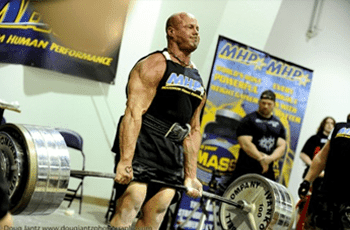
Block pulls done right helped Brandon Cass set multiple Masters world records. Targeted. Specific.
A couple decades ago I trained for a strongman contest with Odd Haugen, back when strongman was the Wild West. There was no standardization and no real concern for objective strength. Events matched the promoter, not the sport. Weak presser? No pressing. No conditioning? Powerlifting with odd objects.
One contest even had a “deadlift” that barely qualified as a lift. Not from the floor. Not even close. It was a rack pull with maybe three or four inches of range of motion. You cracked it loose and they called it a rep. Set up right, it could’ve been a great event. To make it stranger, between events a guy who looked like a pumped up Wesley Snipes was handing out homemade cheesecake (he baked.)
By the end of the event, several of us tied for first place. Not because we were all equally strong, but because the bar bent, jammed into the rack, and physically wouldn’t come off the pins anymore. That should’ve been the first clue this wasn’t about deadlifting.
But contests don’t care about principles. They care about winners. The system was gamed. But you can cry about it and play martyr, or learn the rules, play the game, and kick ass. We chose option B!
We loaded the bar with everything we had. We were already over a thousand pounds. Then heavier plates showed up and it went higher. Then we added bands on top of that. At that point it wasn’t about lifting anymore. It was about bracing, quarter squatting it up, holding it together, and surviving the load.
We’d pick it up and hold it for time. Over and over. Week after week. Ten weeks straight.
And we got really, really good at it.
Here’s the first important lesson.
Size
That training had NOTHING to do with deadlifting.
It had everything to do with exploiting a specific setup, a specific range of motion, and a specific judging standard. It was event prep, not deadlift development.
And yet people started asking me what I was doing for my upper back.
It thickened up dramatically. Traps, rhomboids, erectors, everything. I wasn’t leaner. I wasn’t posing. My upper back just looked like it had been chiseled out of concrete. Gargoyle status. Like my friend Tony, who I used to eat with every day at the LSU buffet and bulked from 180 to 400 pounds, yes you read that correctly.
Grip Strength
Grip strength went through the roof too. We’d go as heavy as possible before using straps, then overload even further. Long holds. Brutal tension. That part absolutely worked.
So yes, rack pull style overload can build a massive upper back. Yes, it can build grip like crazy.
No argument there.
Carryover
Then the contest ended.
I went back to deadlifting from the floor.
And the first time I got down into position, I felt naked.
No tension. No confidence. No strength off the bottom. It felt foreign. Like I hadn’t deadlifted in years. There was zero carryover. Not reduced carryover. Not delayed carryover. Zero.
This wasn’t a phase potentiation situation where you hammer a variation, back off, and a few weeks later you’re money once fatigue clears and skills re sync. This had about as much carryover as a drunken night of karaoke in Okinawa does to playing at Carnegie Hall.
That didn’t happen.It took an entire normal training cycle to rebuild my deadlift past where it had been before that phase.
The grip gains stuck. The upper back hypertrophy stuck. The deadlift strength did not.
And this is where people get confused!
They see someone rack pull massive weight and assume it must help their deadlift. They confuse overload with transfer. Those are not the same thing.
Block vs. Rack Pulls
Block pulls keep the problem honest. The plates rest on blocks, not the bar on steel, so you still have to pull slack, create tension, and bend the bar before it moves. That makes them feel much closer to pulling from the floor.
Fast starters usually hate them. Guys who rip weights off the floor lose that initial speed advantage when the bar is elevated three to four inches. It feels like a dead bench. Hard to start. That is exactly the point.
Block pulls force fast pullers to build real starting strength and better positioning instead of relying on speed. Remember this. Block pulls a few inches off the floor can make the lift harder or help refine it. Rack pulls, even when done correctly and periodized, are usually ego lifts. They can build grip and upper-back strength. Just don’t expect them to build your deadlift.
Intent
Most people set rack pulls where they’re strongest and make sure leverage is perfect. That turns the lift into a confidence drill. Not training. Not problem solving.
Rack pulls only work when they replicate how you miss, not how you look strongest.
That’s why Bill Kazmaier used rounded back rack pulls. He wasn’t being reckless. He was being precise. He trained the position where he failed instead of avoiding it.
So what’s the takeaway?
Rack pulls can build muscle.They can build grip. They can help specific lockout weaknesses.
But short range rack pulls do not automatically build deadlifts. In my case, they didn’t help at all.
Block pulls, especially a few inches off the floor, are a different animal. They preserve slack, bar behavior, and force production demands closer to a real pull. For fast starters, they expose exactly what speed hides.
Final Thoughts
Block pulls, applied correctly, can be a secret weapon. They build position. They expose weak leg drive. They force real speed and force production without momentum saving you. Used in the right phase, they carry over.
Rack pulls are different. When the range of motion gets absurdly short, they’re usually not training at all. They’re a coping mechanism. A way to load plates, make noise, and try to impress the over the hill exotic dancer at the gym.
Done correctly, rack pulls can still build grip and serious upper back hypertrophy. That part is real.
But if your goal is a bigger deadlift, don’t confuse showing off with getting strong. Train what breaks. Set the lift so it tells the truth.
Want real training instead of circus tricks? Grab one of my programs here and train with intent, structure, and results.
👉 HERE