Your PR Is Dying on the Way Down
by- Josh Bryant
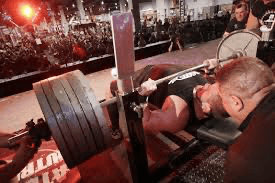
Jeremy Hoornstra is a clinic in precision.
Everybody loves romanticizing old school gyms like they were some big happy brotherhood handing out free advice. As they say in Southern Russian, bullski shitski, y’all.
You walked in green and stayed invisible until you earned your keep. Show up. Shut up. Move iron. After a few months maybe some grizzled bastard grunts at you between bites of chicken and rice. That was respect. That is why it meant something.
That was the world I stepped into in Oxnard at a hardcore gym called Body Shaping. The owner eventually went to prison and the place was renamed Gold’s Gym. Different sign. Same code.
And then there was the bench crew. A truly motley crew.
I used to watch them while I trained with Steve Holl. It was Stan, a one eyed bouncer who supposedly caught a bullet defending the honor of an exotic dancer. A fifty something Japanese doctor benching 400 raw at 190 like it was clinical work. And Hector, built like a tank, ex con local gang leader, some Aztlan playboy in a stringer, girls from a Low Rider cover all over him like white on rice.
The crew did not do small talk. Every Monday was a declaration of war on heavy ass pig iron. Weight moved with intent. Focused violence. The laws of gravity were questioned.
Bar Path
Once I earned a little trust, the Japanese doctor took me to a taco joint run by Sixtoe. No ceremony. Just carne asada, hot tortillas, and nods. Halfway through the meal, he looked at me and kept circling back to the same thing. Touch point on the bench press and bar path. He must have said it ten times. You miss it because you are sloppy. Sloppy touch point, sloppy bar path. Most PRs die on the way down. He emphasized it over and over.
Twenty five plus years later, giving seminars from Okinawa to Oklahoma, I know he had a point. A lot of guys’ touch points are inconsistent as hell. That inconsistency wrecks the bar path, and a wrecked bar path means missed lifts.
The bench is not as technically complex as a snatch, and yes, there is a lot of brute force involved. But it is still a skill. A repeatable skill. Two inches off and you just turned a PR into a third attempt miss.
Fix your touch point and fix your bar path… Here is how.
Pick one touch point, usually somewhere between the nipples and the sternum, and own it on every single rep. Film your sets. Be brutally honest with what you see. If the bar is wandering even a little, fix it immediately. Sloppiness is a choice.
In statistics, one standard deviation from the mean captures about 68 percent of people. Most lifters are going to touch somewhere in that nipple to sternum range. There are outliers. Maybe you are built thick and touch lower. Fine. But whatever your structure dictates, it has to be consistent. Consistent beats so called optimal every time.
And it was not random. The paint was not dripping all over the place. You should have a mark on your shirt about the width of the bar. Not a six inch smear across your chest. One tight mark, same spot every time. If the imprint looks like modern art, your touch point is garbage.
Practice with submaximal weight. Groove the pattern when you are not panicking at ninety percent. You do not build precision in a fire drill.
Practice between fifty five and eighty five percent. Keep the reps low. If you are chasing a one rep max, sets of twenty are noise, not skill work.Think five reps and under. More sets. Fewer reps. Keep fatigue from wrecking the pattern.
Cluster work is perfect here. Short bursts. Reset. Same touch point. Same bar path.The goal is not to get it right. The goal is to make it impossible to get wrong.
Control the descent without turning it into a yoga class. Lower it as fast as you can while still owning the position. Different lifters have different speeds, but the rule is the same. If you cannot hold your touch point and keep the bar motionless on your chest, it is too fast. Do not let it fall on you like dead weight. Earn the speed. Slow it down, lock it in, then build it back up. In powerlifting, motionless means motionless. Control first. Speed second.
Crush the bar. Grip it like you are trying to snap it in half. A hard squeeze lights up the nervous system and recruits more muscle. Loose hands lead to loose presses. That crushing grip creates irradiation. Tension spreads into the forearms, triceps, chest, shoulders, lats, and upper back. Everything fires harder. Stability wins. Pull with the lats. Drive your feet through the floor. Lock everything down before the bar even moves. No leaks allowed.
Pause reps clean this up first. They force you to own the touch point, stay tight, and make the bar motionless on the chest. If you compete in powerlifting, this is part of the game.If you still cannot hold position, Spoto presses can help. But that is a more advanced adjustment. They are not the competition movement. They are a support tool. Use them in the right context. They reinforce the pattern. They do not replace it.
Earn the right to go heavy. If your reps do not look nearly identical, the weight is too much for what you are trying to fix. Build the pattern first, then load it with intent. The initial objective is to bench correctly, not chase a PR every session. Precision first. Numbers follow.
Do purposeful accessories after. The specifics are beyond the scope of this article, but here is the principle. When the right muscles are strong, the technique is harder to mess up.
If practice is in place, improving a lift often comes down to strengthening the muscles that should be doing the work. Your body will recruit the biggest, strongest, most efficient fibers available.
That is why someone with a massive upper back can get a little loose on cheat rows and still hammer the upper back. Or why a guy with big arms can get sloppy on curls and still fry the biceps. The muscle is built. It is available. The nervous system knows where to pull from.
Get the right muscles strong and the technique holds under load.
Final Thoughts
Stop chasing gimmicks. The strongest lifters make heavy weight look boring and predictable. That is the goal.Touch the same spot every time. Own the descent. Build tension before the bar even moves.
Make heavy look routine. Same touch point. Same path. Same result every time.
Do that and the numbers have no choice but to climb.
Locked and loaded!
Better build your bench press with one of Josh’s programs HERE.