
Raise the Ceiling
by- Josh Bryant
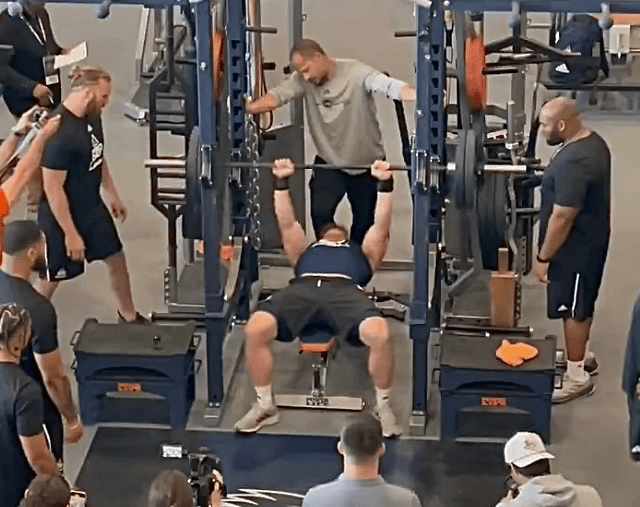
Cade Collenback, the best long snapper in college football, smoked 37 reps at 225 by raising his ceiling.
Whether you’re throwing hands in a melee at a Don Hill cover band in an Okinawa dive bar, fighting off a meth head at Waffle House, breaking tackles on the football field, or helping a buddy move a couch, life almost never demands your maximum force or maximum speed.
That’s why you train to raise your ceiling.
Outside of powerlifting, almost nothing requires 100% of what you’re capable of. The bigger the gap between your maximum capability and what the task demands, the better you’ll perform.
Every pound you add to your squat, every mile per hour you add to your sprint, and every bit of power you develop increases your reserve capacity. When life’s challenges demand only a fraction of what you’re capable of, you perform better, fatigue less, and become much harder to break.
Don’t train to live at your limit. Train to raise your ceiling. That’s the game.
Strength
Think about the NFL Combine bench test. The weight is always 225 pounds. If your bench max is 300, you’re pressing 75% of your max, and most lifters will get around 10 reps. Build that bench to 450, and now 225 is only 50% of your max. Twenty or more reps suddenly becomes realistic. No drop sets. No tempo work. No occlusion training. No endurance circle jerk. You didn’t find a secret—you raised your ceiling.
Sure, those methods have their place. But none of them move the needle like adding 150 pounds to your bench. The quickest way to improve a submaximal task is often to become much stronger than the task requires.
The same principle carries over to speed. McBride and colleagues found Division I football players squatting at least 2.1 times bodyweight sprinted significantly faster over 10 and 40 yards than players squatting 1.9 times bodyweight or less. They weren’t just better squatters. They could put more force into the ground, and the stopwatch noticed.
Power follows the same pattern. Wisløff found maximal squat strength was one of the strongest predictors of vertical jump performance in elite professional soccer players. A bigger engine produces more horsepower. That’s why stronger athletes generally sprint faster, jump higher, and produce more power.
Strength even builds a type of endurance most people never think about. Not marathon endurance. Reserve capacity. Every task becomes less demanding because it requires a smaller percentage of your capability.
I saw it when we moved into our house. We hired professional movers, but when it came time to unload the garage gym, I told them to take the boxes while I handled the plates, bars, and machines. Those guys were absolutely smoked. To them, a 100-pound plate was a max-effort event. To me, it was another trip to the truck because my ceiling was so much higher.
Most people spend their time trying to make the task easier. I’d rather become so capable that the task barely registers. Whether you’re breaking tackles, carrying feed buckets, loading a wild hog into the truck, moving furniture, or beating the church crowd to the front of the chow line at Golden Corral, life almost never demands your maximum.
Raise your ceiling, and everything below it gets easier.
Heavy carries raise the ceiling
Speed
Running works the same way. Drive by almost any youth sports complex and you’ll see the conditioning cosplay in full swing. Kids bent over, sucking wind, some decorating the grass with their lunch, all because somebody confused conditioning with speed. Fatigue doesn’t teach you to run fast. It teaches you to run tired. We’ll save that rabbit hole for another day. Just know they’ve got it backwards.
Think about a football player. He might hit 22 miles per hour once or twice all season on a breakaway run. What wins games isn’t touching 22. It’s getting to 19 over and over again. If his top speed is only 20 miles per hour, then 19 is practically an all out sprint every time he touches the ball. Raise his top speed to 23, and now 19 is just another gear. Same play. Same distance. Same opponent. Less effort.
Derek Hansen calls this the speed reserve. Increase an athlete’s maximum velocity from 10.9 to 11.8 meters per second, and every sprint during the game becomes a smaller percentage of maximum effort. Suddenly everyone thinks the athlete has incredible conditioning, even though he never ran one extra gasser .The ceiling moved. Everything underneath it got easier.
There’s another benefit people rarely talk about. Sprinting at 80 percent of max instead of 95 percent places less stress on the hamstrings, ankles, and knees with every stride. You can argue over Nordic curls, mini bands, activation drills, and whatever the latest social media flavor of the month is. Or you can build a bigger speed reserve and stop asking your tissues to live on the ragged edge every single play.
Raise the ceiling. The rest takes care of itself.
Power
Power sits on top of strength and speed because it’s simply how quickly force gets applied.
Here’s what most people don’t realize. During a maximal voluntary contraction, it can take more than 500 milliseconds to reach peak force. An elite sprinter’s foot is only on the ground for roughly 80 to 100 milliseconds at top speed. Sport almost never gives you enough time to express all of your strength.
Athletes are always working off a fraction of their maximum. Raise that maximum, and the fraction gets bigger too. If two athletes have the same ground contact time, the stronger athlete still produces more force because half of a bigger number beats half of a smaller one. The window didn’t change. The athlete did.
That’s why stronger athletes tend to sprint faster, jump higher, change direction quicker, and hit with more authority. They aren’t bending the laws of physics. They simply built a bigger engine.
None of this requires another conditioning circuit, another gimmick, or another “functional” exercise dreamed up for social media. It requires raising the ceiling through intelligent strength and speed training, then letting the math do what it always does.
Raise the ceiling and you’ll sprint faster, cut quicker, produce more power, build a stronger posterior chain and trunk, become more resilient, improve your conditioning because every task becomes more submaximal, and probably carry a little more muscle along the way.
Final Thoughts
Most people spend their lives trying to make the task easier. I’d rather become so capable that the task barely registers. Whether you’re breaking tackles, carrying feed buckets, loading a wild hog into the truck, moving furniture, or beating the church crowd to the front of the chow line at Golden Corral, life almost never demands your Josh Brymaximum.
If you’ve ever wondered why it’s worth getting stronger, faster, and more powerful, this is why.
Raise the ceiling. Everything underneath it gets easier.
That’s not a slogan. That’s physics.
Raise the ceiling with a JoshStrength program HERE