
WHEN YOUR TRAINING METHOD BECOMES YOUR PRISON
by- Josh Bryant
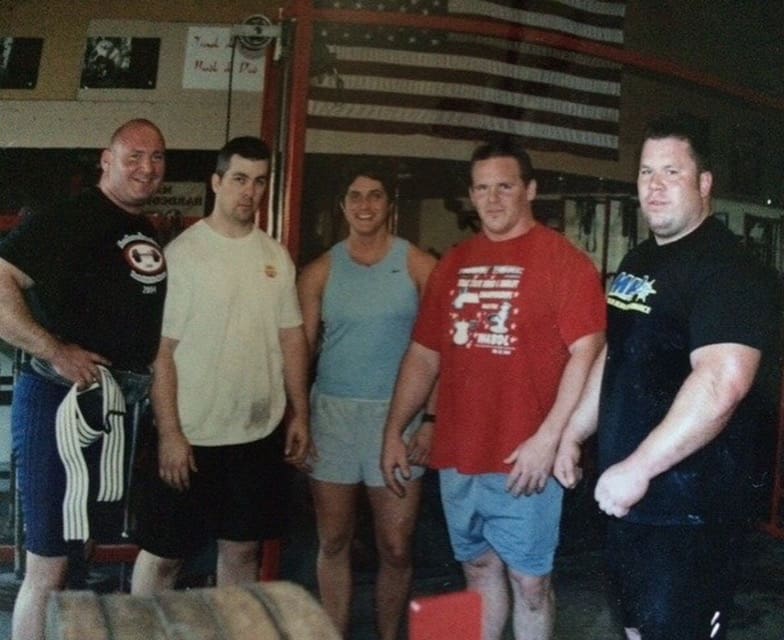
Josh Bryant training with Paul Leonard, Mike Martin, and company at Martin’s Barbell in Denton, Texas, 2005.
Two of the most memorable characters I encountered in weight rooms taught me more about training than they probably realized. One was a gentle giant. The other was a notorious skirt-chasing redneck Romeo.
From about age five to twelve, I used to sneak into the weight room at the local YMCA. One of the regulars was an old head named Rudy.
Rudy was probably 6’4″, 300 pounds, and pushing 70. He was a stickler for the rules and had no problem straightening out the occasional punk, but he always turned a blind eye to me being there. He encouraged me, and I’ll forever be grateful.
From what some of the older guys told me, Rudy had been hell on wheels in his younger days. The old joke was that before a football game, somebody would ask, “Where’s Rudy?” The answer? “Probably outside chewing the tires off the team bus.” By the time I knew him, he’d mellowed into a gentle giant.
Rudy trained religiously. He also drank a gallon of orange juice throughout the day, often putting away half of it during his workout. Unfortunately, his physical condition kept getting worse. He gained weight, moved slower, and accumulated injuries. Full bench presses became half reps. Half reps became quarter reps. At that rate, I figured he’d eventually be doing isometric holds without knowing it.
What struck me was that nothing changed. Same exercises, same routine, same approach, regardless of what his body was telling him. Rudy had a tremendous work ethic, but he’d become a prisoner of his training method.
About a decade later, at a gym I trained at occasionally in East Texas, I encountered the opposite.
His name was Rod.
Rod had reportedly played in the NFL. He was 55ish, freshly divorced, and still jacked. His football days were behind him, but he’d found a new sport. He’d traded playing on the football field for playing the field, and from what I could tell, he was putting up Hall of Fame numbers.
Rod was actually pretty intelligent in the weight room, except when an attractive woman showed up. Then his training IQ occasionally dropped 50 points, and the workout became an audition for the Chippendales. Fortunately, that only happened about once a week.
The rest of the time, Rod trained with purpose. Years of football had left him banged up, and his days of training strictly for strength and power were behind him. He wanted to look good, feel good, and remain physically capable of pursuing his extracurricular activities.
He shifted toward bodybuilding, trained muscle groups he’d neglected, and stopped treating every workout like an NFL combine. He dropped weight, improved his mobility, and became healthier and more functional.
Here’s the irony. Rudy was the kind of man you’d want your son to look up to. Rod was the kind of man you’d warn your daughter about. Yet when it came to training, Rod understood something Rudy never did.
Rudy was loyal to his routine. Rod was loyal to his objective.
Gravity doesn’t care whether you’re a saint or a skirt chaser. Neither do the biological principles of use and disuse or individual differences. You’re a biological organism, and you’re not even the same individual you were ten years ago. Your strength, recovery, injury history, responsibilities, and goals change. Why should your training remain frozen in time?

If you’ve spent your life chasing heavy weights, build some muscle to back them up with my 1-10-1 Powerbuilding Program.
WHEN SUCCESS BECOMES A TRAP
I’ve watched training methods produce tremendous results. I’ve also watched coaches become so attached to those methods that they’d rather explain away poor results than change anything.
It usually starts innocently. A coach discovers an approach that works. Athletes improve, his confidence grows, and he becomes known for that particular system. Nothing wrong with that. You should believe in what you’re doing.
But there’s a difference between confidence and dogma.
A confident coach understands why something works and when to apply it. A dogmatic coach assumes that if it doesn’t work, the athlete must be the problem.
I’ve learned from some tremendous coaches over the years, including men whose philosophies differed substantially from mine. Some reinforced my beliefs, while others changed them. A few things I believed twenty years ago, I now consider wrong.
If you’re coaching exactly as you did two decades ago, either you were a genius at 25 or you haven’t learned much since. My money is on the latter.

If you’ve spent your life chasing heavier weights, it’s time to build speed, power, agility, and movement capacity with Excessive Force, my program with Tom Haviland.
WHEN YOUR METHOD BECOMES YOUR BRAND
Social media has made this problem worse. A coach gets results, develops a following, and builds a business around his system. Soon there are seminars, certifications, books, and programs. Good for him. Knowledge has value.
But what happens when the evidence suggests another approach might work better?
Now changing his mind threatens more than his ego. It could threaten his brand and livelihood. Suddenly, every successful athlete becomes proof that the system works, while every unsuccessful athlete becomes evidence that somebody didn’t follow the instructions.
Maybe the athlete didn’t recover properly. Maybe he lacked discipline. Maybe his genetics weren’t suited to the program. Sometimes those explanations are legitimate, but if every success proves your method works and every failure is somebody else’s fault, you’re running a cult. The only thing missing is Jim Jones passing out the Kool-Aid.
I’ve seen coaches become so invested in a particular periodization model that they treat alternatives like heresy. The conjugate guy thinks everybody needs more variation. The linear periodization guy thinks everybody needs another carefully planned progression. The high-frequency advocate wants more exposures, while the low-frequency guy thinks everybody is overtrained.
Each might have something valuable to offer. The problem starts when the answer is decided before the athlete walks through the door!
I MADE THIS MISTAKE MYSELF
For years, I placed tremendous emphasis on progressing accessory lifts. If I was doing an exercise, I wanted to get stronger at it. Progressive overload matters, and I’m not about to suggest otherwise.
But eventually I noticed I was chasing accessory PRs with the same reckless enthusiasm Rod chased divorced waitresses at happy hour. Range of motion shortened, momentum increased, and other muscles started taking over. The weight went up, but the intended training effect didn’t necessarily improve.
I’d turned the measurement into the mission.
If an exercise is supposed to build the triceps, improve a weak point, or support a competition lift, judge it by that objective. Adding 20 pounds to a movement means little if you’ve changed the execution so much that it no longer accomplishes its purpose.
I’m not against accessory PRs. I’m against forgetting why you’re doing the exercise. The same mistake can happen with an entire training system.
PRINCIPLES AREN’T METHODS
Specificity, overload, recovery, and individualization are training principles. Exercises, rep schemes, frequencies, and periodization models are methods used to apply them.
Consider two powerlifters. One thrives on frequent heavy singles and relatively low accessory volume. Another makes his best progress with more submaximal work, higher volume, and fewer maximal exposures.
If you insist on giving both lifters the same approach because your favorite system demands it, you’re no longer coaching individuals. You’re forcing individuals to accommodate your system.
Your own training experience is valuable, but it’s not a universal law of physiology.
Of course, adaptability doesn’t mean changing programs every time somebody has a bad workout. Training adaptations take time, fatigue can temporarily mask progress, and one lousy session doesn’t justify throwing six months of planning in the trash.
Sometimes you need to stay the course. Other times, the evidence demands a change. Look at performance trends, recovery, execution, and the athlete’s circumstances before making that decision.
A good coach changes the program when the evidence changes. A bad coach changes the explanation.
THE IRON DOESN’T CARE ABOUT YOUR PHILOSOPHY
I’ve coached world-record holders, elite athletes, tactical athletes, and people from just about every walk of life. One thing that experience has reinforced is that nobody has a monopoly on good ideas.
A method can produce excellent results without being appropriate for everybody. You can disagree with someone’s overall philosophy and still learn something valuable from him.
I want to be a better coach ten years from now than I am today. That won’t happen if I spend the next decade defending every decision I’ve already made.
Have convictions. Understand your principles. Use methods that have earned your confidence. But don’t become so attached to a method that you forget why you’re using it.
Your methods are tools, not handcuffs.
And the barbell doesn’t give a rat’s ass about your brand.

If you’re a slave to training five or six days a week, break free with my Three Day Detail Off-Season Powerlifting Program. Three days a week. More isn’t better. Better is better.