
Build Everything. Emphasize One!
by- Josh Bryant
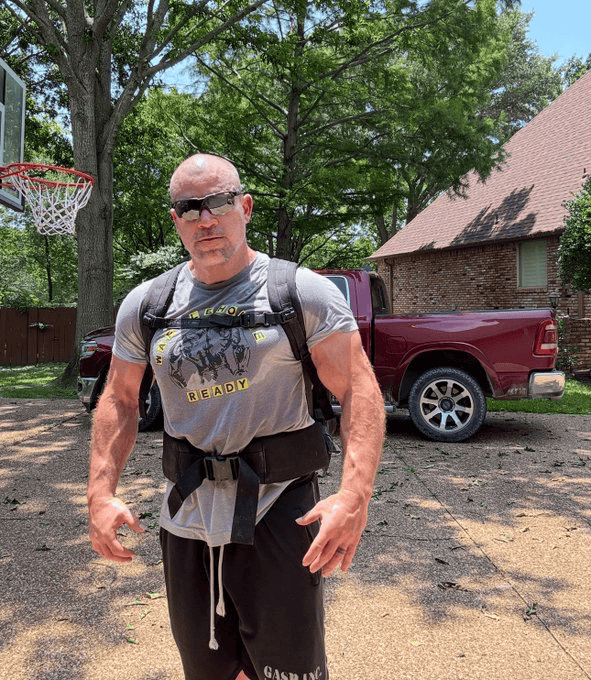
Rucking year-round so my engine never disappears.
Back in 2006, I was eating breakfast at the Waffle House off Boulevard 26 in North Richland Hills with a six-foot-eight preacher we called Brother Barrett. He preached at a rural cowboy church, and to this day I have no idea why he drove all the way over there for breakfast, but he did.
Brother Barrett was about as ugly as Randy Johnson in his pitching days, but he had the charisma of Zig Ziglar and could command a room like Tony Robbins. When Barrett started talking, people listened.
That morning he was giving relationship advice to some young guy bragging about enjoying all the benefits of marriage without any of the commitment. Barrett looked up from his hash browns, pointed his fork across the table, and said, “Boy, if a deal’s too good to be true, it is. Every piece of bait has a hook under it.”
I’ve thought about that line for years because it applies to strength training just as much as life.
Every exercise, every training method, and every training modality has a hook. That hook might be fatigue, recovery demands, time, specificity, or opportunity cost. Every adaptation has a price tag.
Spend all year chasing maximal strength and eventually fatigue catches you. Outside of powerlifting, you also risk building an artificial strength base. It’s great that your squat goes up, but if your speed, conditioning, and ability to express that strength go down, what’s the point?
Spend all year chasing conditioning and absolute strength starts slipping. Spend all year chasing hypertrophy and speed, explosiveness, and rate of force development begin to fade.
Great coaching isn’t about avoiding the price. It’s about deciding which bill is worth paying.
The biggest mistake isn’t failing to periodize. It’s thinking emphasizing one quality means abandoning the others. The goal isn’t to build everything equally. The goal is to build everything eventually.
One quality gets the biggest slice of the pie while the others receive enough work to maintain the adaptations you’ve already earned. Then the emphasis rotates.
Think of your physical qualities like a stereo with five volume knobs: strength, power, speed, conditioning, and hypertrophy. Most coaches either crank one knob to ten and turn the others to zero, or they leave every knob stuck at five. Neither works. Great coaching is knowing which knob deserves to be turned up while the others stay high enough that they never disappear.
That philosophy has guided my programming for years. My goal is simple: develop the strength and power of someone fifty pounds heavier while moving and conditioning like someone fifty pounds lighter. You don’t get there by trying to improve every physical quality equally. You get there by knowing when to build, when to maintain, and when to rotate the emphasis.
This isn’t just coaching philosophy. It’s physiology.
Some qualities take years to build but surprisingly little work to maintain. We’ve all seen the old head at the gym who built an incredible strength base over thirty years. He warms up, benches one heavy set, spends the next hour solving the world’s problems between sets, and still outlifts almost everyone in the building. Maintaining strength requires far less work than building it.
The same principle applies to aerobic conditioning. Build a serious engine and you can maintain most of it with a fraction of the work it took to develop.
Speed is different.
Every maximal sprint places enormous stress on the hamstrings, soleus, Achilles tendons, hips, feet, and connective tissue. Those tissues adapt over months and years. Eliminate sprinting because you’re in a “strength phase” and you don’t just lose speed—you lose tissue tolerance. Your lungs may be ready long before your hamstrings and Achilles tendons are.
That’s why football players still sprint during strength phases. Tactical athletes still need exposure to speed, power, and conditioning year-round. Even powerlifters benefit from explosive intent and enough athleticism to tolerate more quality training.
The dose changes.The qualities don’t.
Every time I write a program, I’m asking the same questions. What movement patterns matter most? Which energy systems dominate the sport or occupation? How much force has to be produced, where is it produced, and how quickly? What type of muscular work is required—concentric, eccentric, isometric, explosive, or reactive? Finally, what’s the total cost to the athlete’s finite recovery reserves?
Thirty years ago, nobody talked about tactical athletes. Today we understand that a SWAT operator, firefighter, or patrol officer deserves the same level of programming sophistication as an NFL linebacker or Olympic athlete. The principles don’t change. The game changes.
Yuri Verkhoshansky called this dynamic correspondence. Great training doesn’t transfer because an exercise looks like the sport. It transfers because it develops the qualities the task demands. Where is force produced? In what direction? How quickly? For how long? What type of muscular action dominates? Answer those questions correctly and the transfer takes care of itself.
Over the years, one thing I’ve changed my mind on is exercise selection. I used to believe certain exercises were inherently superior. Today I believe exercises are tools, with competitive powerlifting and Olympic weightlifting being the obvious exceptions because competition dictates specificity.
All that matters is the adaptation we’re chasing. If two exercises accomplish the same adaptation, let the athlete’s preference improve adherence. If one tool is clearly better because of leverages, injury history, mobility, or sport demands, use the better tool and move on.
The athlete doesn’t owe an exercise anything.The exercise owes the athlete a result.
Call it vertical integration. Call it periodization. Call it strength and conditioning. I don’t care what you call it.
Be a whore for results, not methods.
Chase adaptations, not dogma.
Train with purpose. Adapt with intent. Program in the link.