13 Lessons From a Lifetime Under the Bar
by- Josh Bryant
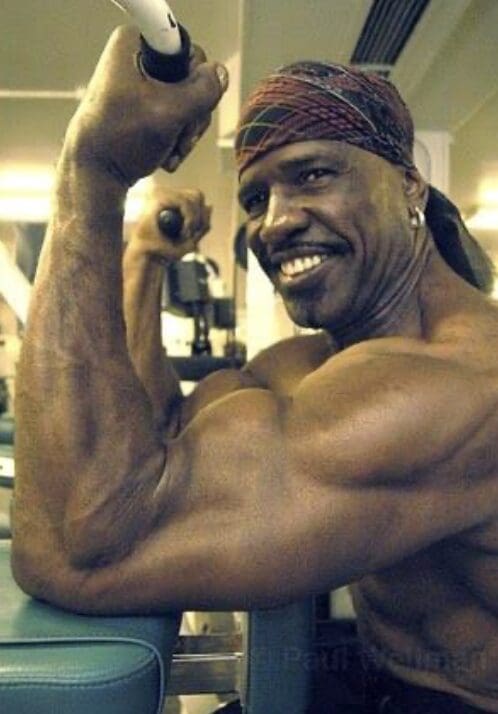
Carl Gaines
My first job was at 14, hauling Christmas trees to cars and making deliveries. Despite California’s notoriously strict labor laws, the only way to get a break was to smoke. Our fat, perpetually energetic manager eventually got a pink slip when his secret turned out to be cocaine, not preworkout. But that’s another newsletter.
By 16, I was managing Santa Barbara Gym & Fitness after football practice and on weekends. The place attracted bodybuilders, powerlifters, strip club bouncers, strippers, field workers, and an Army Ranger who’d been in about a dozen knockdown, drag-out freeway brawls. Naturally, every one was somebody else’s fault. We accepted cash dues, no credit card required.
I’ll never forget Carl Gaines, a champion natural bodybuilder and quintessential 1990s musclehead. Picture Michael Jai White from Black Dynamite walking into a hardcore gym, ready to train heavy or tell bodybuilding stories at the front desk.
Carl trained heavier, rested longer, and trained less frequently than the other bodybuilders. When my incline bench stalled, he introduced me to heavy negatives. His philosophy: “I go heavy, I go hard, and I don’t train as often because my workouts take more to recover from.”
He understood that not all training carries the same recovery cost. That gym was my classroom. I’ve continued learning from lifters and athletes ever since. Here are 13 lessons that stuck.
1. Strength Is Harder to Build Than Maintain
Maintaining strength generally takes less work than building it. The same applies to speed, endurance, and muscle, although the requirements differ.
Spent six months improving your squat but now want a faster mile? Keep a small dose of heavy lifting rather than throwing away the strength you’ve earned. You can shift the emphasis without abandoning everything else. Why rebuild what you could’ve maintained?
2. Easy Gainers Don’t Need More Work
Some people grow from little training; others need more stimulation. Yet some coaches automatically prescribe less to hard gainers.
You flunked bonehead English and science at the local junior college—remedial classes that don’t even count toward college credit—and now you want to go to medical school? You better hit the damn books!
Nobody suggests studying less because you’re academically behind. Training shouldn’t automatically work that way either. Recovery matters, but determine the individual’s productive workload instead of assuming every poor responder needs fewer sets.
3. Five Sets of Five Aren’t Created Equal
One lifter squats 225 for five sets of five; another squats 600. Same reps, potentially very different recovery costs. Carl knew heavy training could demand more downtime.
And you’re a biological organism, not a machine. Two equally strong lifters can respond differently, and one lifter’s tolerance changes with sleep, stress, age, and accumulated fatigue. Coach the person in front of you, not the spreadsheet.
4. Success Begets Success
Good boxing managers build prospects against tomato cans before stepping up the competition. You don’t win a slap-boxing match at the country club’s debutante ball and head straight to Nuevo Laredo for a bare-knuckle fight with the toughest bastard in town.
Training should also accumulate successful experiences. Constantly missing lifts can undermine confidence; well-chosen challenges and progressively heavier successful reps build it. Eventually you need somebody who fights back. There’s no prize for skipping the progression.
5. You Can’t Outrecover Stupid Programming
Cold plunges, massage guns, compression boots, and enough wearable technology to make NASA jealous all have their fans. Some are useful. None can routinely rescue a lousy training plan.
If volume is excessive and every set is a death match, examine the program before buying another recovery gadget. I’d rather see half as many sets performed with the right intent and execution than twice as many sets of someone just going through the motions.”
6. Build Everything. Emphasize One.
Football players and tactical athletes need strength, speed, power, and conditioning. Trying to maximize all four simultaneously can create competing demands.
Pick the main objective, give it the lion’s share of resources, and maintain the other qualities with enough work to keep them. When priorities change, rotate the emphasis. You don’t need to become slow to get strong.
7. The Better You Get, the More Expensive Progress Becomes
At 11, you ran a 5.4-second 40. At 23, you run a 4.4. You’re now producing much greater forces at higher velocities. Better work capacity doesn’t grant permission for endless maximal sprints. That’s how you burn yourself to shreds.
Likewise, taking a squat from 700 to 800 isn’t the same task as moving from 200 to 300. Advanced performance usually demands more precise programming for smaller improvements.
8. Train the Quality, Not Just the Exercise
Somebody wants box squats, bands, chains, and a specialty bar. Fine. What’s the objective?
Maximal strength? Explosive strength? Hypertrophy? A weak position?
A moderate-load box squat moved explosively isn’t the same stimulus as a grinding max. Loading, intent, execution, and volume matter. Choose the tool for the job, not a job for your favorite tool.
9. Minimum Effective Dose Beats Maximum Tolerable Dose
How much work can you survive? How much do you need to improve? Different questions.
Paraphrasing Soviet sports scientist Yuri Verkhoshansky, any idiot can make another idiot tired.
If three hard sets produce the desired result, what do the next seven buy you? Additional volume has its place, but exhaustion isn’t proof of progress. Plenty of guys can survive an ass kicking; that doesn’t mean they need one three times a week.
10. Your Weakest Link Dictates Your Ceiling
I’ve trained strong athletes who couldn’t express force quickly and explosive athletes whose conditioning fell apart.
If a football player accelerates beautifully but loses separation at top speed, more ten-yard starts probably aren’t the answer. Work on maximal velocity. If your deadlift collapses off the floor, endless lockout work might miss the problem.
The caveat? You always want to bring your biggest gun to the fight. Don’t let a strength become a weakness while trying to bring up a weakness.
Devote enough training resources to improving your limiting factor while maintaining the qualities that already give you an advantage.
11. Fatigue Can Hide Fitness
One lousy workout doesn’t mean you’ve lost strength. Training builds adaptations and fatigue; the latter can temporarily hide the former. Reduce fatigue and suddenly the weights move again.
Don’t overreact to one bad day, and don’t redesign everything after one freakishly good day either. Watch the trend. That’s why reloads and meet tapers exist.
12. General Physical Preparation Raises Your Ceiling
I’m not asking powerlifters to become marathoners. But if walking to the drinking fountain leaves you winded, there’s room to improve.
Sled drags, loaded carries, rucking, and sensible aerobic work can build the capacity to train and recover. Conditioning should support the main objective, not sabotage it. A 700-pound squatter shouldn’t need a nap after carrying in groceries.
13. Don’t Fall in Love With Your Tools
I’ve used bands, chains, specialty bars, partials, eccentrics, and isometrics. They can all work. Trouble starts when a coach prescribes a favorite method regardless of the athlete.
Accommodating resistance isn’t automatically right for everybody from beginners to world champions. If a simpler approach solves the problem, use it. You’re coaching an athlete, not selling equipment.
Final Thoughts
At 16, I learned from champion bodybuilders, powerlifters, and grizzled lifters with decades under the bar. That’s still how I approach coaching: figure out what works, for whom, and why. There’s always something else to learn.
Put decades of my coaching experience, from world champions to professional athletes, to work in your own training.
Get Started With My TrainHeroic Programs HERE.