
Bench More to Run Faster?
by Joseph Giandonato, PhD, MBA, CSCS
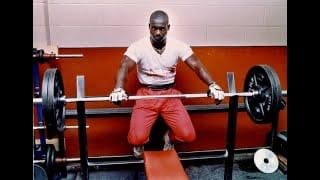
Few exercises stimulate more debate and evoke more bravado and tales from the trenches [or a non-existent athletic prime] than the bench press.
Introduction
For years, the “functional training” crowd devoid of any licensure as physical therapists or athletic trainers denounced the bench press as a caveman movement that was deleterious to shoulder health. In defense of these weekend workshop attendees and one PubMed abstract reading pontificators, the bench press is a contraindicated movement for some people and since your shoulder blades are pinned against the bench, the scapulae don’t glide freely across the ribcage as they would in a push-up.
And scapular upward rotation is a critical component to upholding scapulohumeral rhythm or the sequence in which the shoulder blades move in relation to and initiate movement of the arms overhead. But scapular upward rotation and the scapulohumeral rhythm it encompasses are more important to overhead movements and throwing motions than they are the bench press.
And though push-ups are extremely versatile, they can’t be heavily loaded safely or efficiently. Try telling a 405-pound bencher to pile plates on their back without assistance before descending into their first rep. Not gonna happen! Like fellow compound movements, the bench press builds limit strength, whereas push-ups have a limited ceiling beneath which strength can be built.
Purpose
The bench press can actually be leveraged as tool to get faster…as a runner or sprinter.
For starters, the bench press requires the recruitment of countless motor units distributed throughout the movement’s agonist or prime mover muscles: the pectoralis major, anterior deltoid, and triceps.
At higher loads and at faster velocities, greater muscular forces are required. And greater muscular forces require the activation of high-threshold motor units — large alpha motor neurons which innervate hundreds to potentially thousands of Type II muscle fibers.
And though bench pressing may lack the dynamic correspondence or “direct transfer effect” to sprinting like resisted sled sprints, lunges, and Olympic lifts, bench pressing with circamaximal loads and/or with circamaximal velocity can still optimize functioning of the central nervous system.
Acutely, maximal voluntary contractions occurring during the execution of movements with near-maximal external loads or performed at near-maximal velocities can sensitize excitatory synaptic junctions between neurons and lead to greater excitatory post-synaptic potentials.
Over time, the recruitment and discharge frequency of motor units will be streamlined as neural adaptations take hold. Selective recruitment of high-threshold motor units will become a mainstay for hastened force production as low-threshold motor units will begin to be bypassed resulting in hastened contraction forces and speed of contractions.
Rationale
Maximal effort bench pressing contributes to increased functional stiffness of the torso during sprinting, which aids in force transference through the core and redirects ground reaction forces into forward momentum.
Additionally, maximal effort bench pressing will help improve upper body power which is critical to facilitating rapid arm action which facilitates greater leg drive and synchronizes stride cadence — linking contralateral limbs (e.g., right arm and left leg and left arm and right leg) — which is critical during acceleration and achieving and sustaining peak horizontal velocity, or maximum sprinting speed.
Also, maximal effort bench pressing can be utilized to maintain a training effect — particularly to prime and optimize CNS functioning without beating up the lower body. This is critically important for sprinters who devote 3-to-4 days or more per week performing Olympic lifts, squat and deadlift variations, plyometrics, and repeats to build up and maintain their training tolerance.
And there is some data to support bench pressing to improve sprint performance. Bench press performance was found to be significantly correlated with 10-meter repeat sprint ability (Ingebrigtsen & Jeffreys, 2012). These findings were echoed by subsequent studies that demonstrated relationships between bench press strength and more broadly upper body strength and sprint performance (Balsalobre-Fernández et al., 2014; Tunçel et al., 2023).
And lastly, if the reasons or literature findings aren’t convincing enough, reigning 100-m Olympic gold medalist, Noah Lyles, regularly incorporates the bench press in his training and former NFL speed demon, Tyreek Hill, who at one time was an accomplished collegiate sprinter at Oklahoma State University, reportedly maxed out with 345 pounds on the bench.
Conclusion
The bench press as a standalone will not make you an elite sprinter, but it will round out a comprehensive program that checks all the other boxes. Think of the bench press as icing on the cake or a nutrient dense side salad to a multiple course meal — lower body strength and power may be greater determinants in sprint speed — they’re your steak and potatoes — but having sufficient upper body strength, much like a palatable dessert or nutritious salad, is absolutely imperative.
References
Balsalobre-Fernández, C., Tejero-González, C.M., del Campo-Vecino, J., Bachero-Mena, B., & Sánchez-Martínez, J. (2014). Relationships among repeated sprint ability, vertical jump performance and upper-body strength in professional basketball players. Journal Archivos de Medicina del Deporte, 31(3), 148-153.
Ingebrigtsen, J. & Jeffreys, I. (2012). The relationship between speed, strength, and jumping abilities in elite junior handball players. Serbian Journal of Sports Sciences, 6(3), 83-88.
Tunçel, A., Harbili, S., & Harbili, E. (2023). The correlation of strength with endurance, Sprint, and repeated sprint in young soccer players. International Journal of New Trends in Arts, Sports & Science Education (IJTASE), 12(3), 182–188. https://ijtase.net/index.php/php/article/view/126